
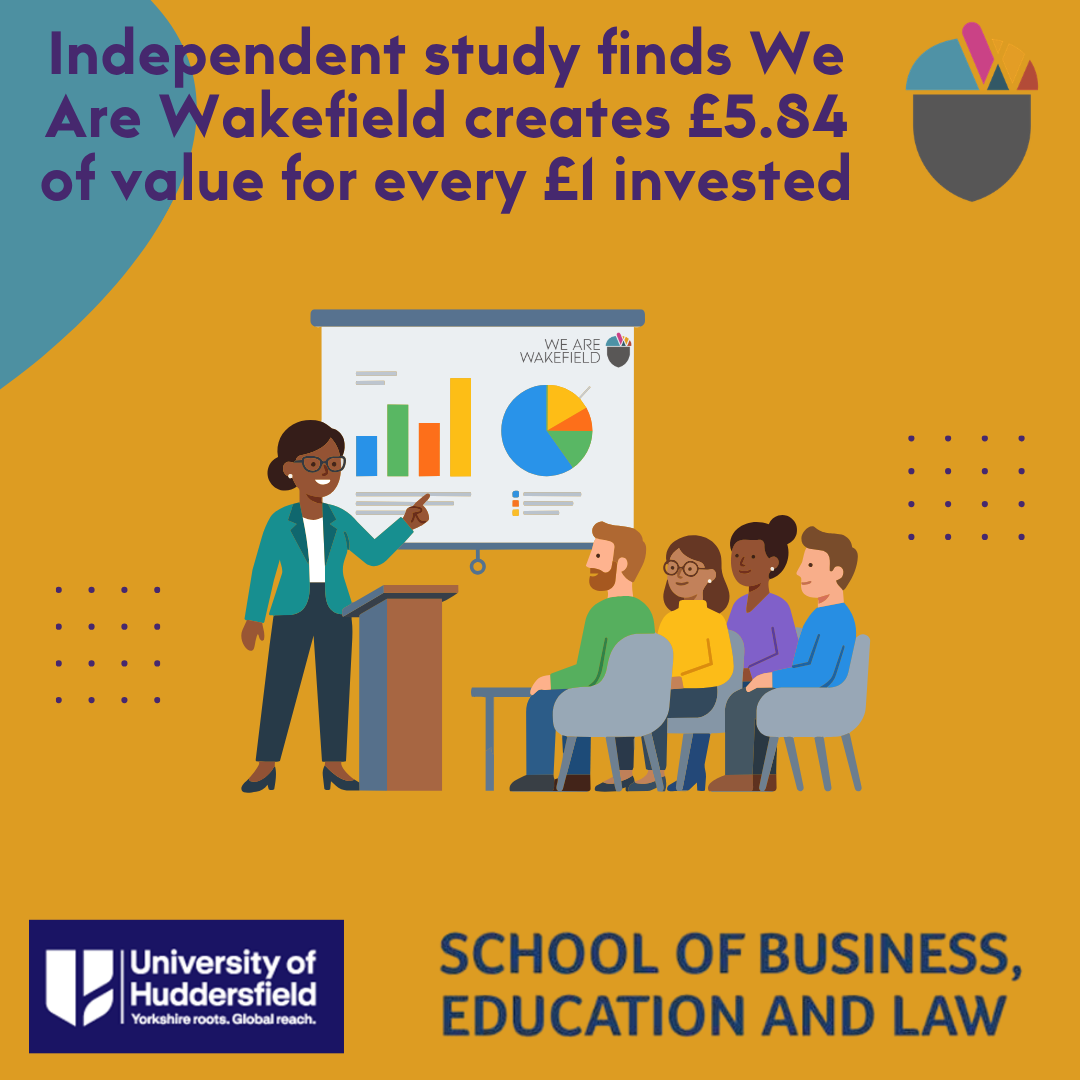
New research by University of Huddersfield Master’s students has independently examined the impact of We Are Wakefield. The findings reveal measurable commercial returns for members, stronger local supply chains and wider benefits for organisations, communities and the Wakefield district.
Many We Are Wakefield members will remember being invited to complete a survey or take part in an interview earlier this year. Those contributions formed part of an independent consultancy project undertaken by a team of Master’s students from the University of Huddersfield.
The completed study set out to answer an important question: what difference does We Are Wakefield make?
Rather than simply measuring the number of events delivered or people attending them, the researchers examined the changes resulting from members’ involvement. This included new business, cost savings, stronger professional relationships, increased visibility, access to expertise, community collaboration and the wider value generated for the Wakefield district.
The result is the most detailed independent assessment of We Are Wakefield’s impact to date, and the findings provide compelling evidence of the value created by our network.
£5.84 of value for every £1 invested
The headline finding is an indicative Social Return on Investment of £5.84 for every £1 invested by participating members.
This calculation looked beyond the cost of membership alone. The researchers also included the value of the time members committed to attending events and any other associated costs. Across the 17 responses used for the detailed financial analysis, the total calculated investment was £46,464. The adjusted social and economic value generated was £271,208.
The researchers took a deliberately cautious approach. Reported outcomes were adjusted to consider dead weight, which is the proportion of an outcome that might have happened anyway, and attribution, which considers the contribution of other people or organisations. Where information was incomplete, conservative assumptions were used rather than overstating the results.
This means that the £5.84 figure should be viewed as an indicative return based on the participating sample, rather than a definitive valuation of the whole network. Nevertheless, it offers strong independent evidence that members’ investment of money and time is producing meaningful economic and social value.
New business and direct cost savings
The research found clear commercial benefits for many participating members:
- 82% reported securing new business through We Are Wakefield.
- 59% reported achieving direct cost savings.
- Members rated the network highly for raising visibility and awareness and creating valuable professional connections.
 Interview participants gave examples of new customers, suppliers, referrals, commercial bookings and longer-term partnerships. One participant estimated that their engagement had contributed to a 5% to 10% increase in profitability, while another reported three potential new clients generated through the network.
For some organisations, the impact was already reflected in confirmed income or savings. For others, the value was developing through new conversations, prototypes, partnerships and opportunities progressing through their pipelines.
This is an important distinction. Business relationships do not always produce an immediate transaction. A conversation at First Friday might lead to an introduction, which becomes a proposal, which develops into a customer or partnership several months later. The research recognised that We Are Wakefield’s impact often grows over time as relationships deepen and trust develops.
Keeping business within the Wakefield district
The study also highlighted We Are Wakefield’s role in encouraging organisations to source products and services locally.
Members described finding new Wakefield-based suppliers through introductions, events and recommendations from trusted contacts. One interview participant reported identifying five new suppliers through the network, with some of those relationships becoming ongoing contracts.
This local sourcing created several benefits. Members reported improved buying rates, reduced travel, greater confidence in their purchasing decisions and faster access to the right support. Most importantly, money spent with local suppliers is more likely to remain within the district and contribute to the strength and resilience of Wakefield’s economy.
The findings show that We Are Wakefield does not simply connect individual businesses. It helps to create a more visible and accessible local supply chain in which members can buy from, recommend and support one another.
Trust is at the heart of the network
Across the interviews, one of the clearest and most consistent themes was the value of trusted, face-to-face relationships.
Participants explained that warm introductions and personal recommendations gave them access to people and organisations they might otherwise have struggled to reach. These connections were seen as more effective than cold calling, online searches or purchasing from an unknown supplier without a recommendation.
One participant said:
“It can be quite lonely running a business… the opportunity of meeting other like-minded business leaders was what attracted me.”
This sense of connection was particularly important to smaller organisations and those without dedicated business development, marketing, HR or procurement teams. For them, We Are Wakefield provided access to a much wider community of knowledge and expertise.
Members spoke about being able to contact trusted people for HR guidance, technology support, marketing advice, funding information, training and specialist services. The network was described as a first point of contact when an organisation encountered a challenge or needed to find someone with the right experience.
The study concluded that We Are Wakefield’s greatest value does not lie in one event, newsletter or individual service. Its real strength is its ability to create and sustain relationships, trust, knowledge exchange and access to opportunity.
Reducing isolation and increasing confidence
The value of membership was not only expressed in pounds and pence.
Several participants spoke about the isolation that can accompany running a business or leading an organisation. Being part of We Are Wakefield gave them a community of peers who understood their challenges and could offer practical advice, reassurance and encouragement.
For one small business, membership helped to reduce anxiety around business development and created greater confidence about the organisation’s direction. Engagement with members also influenced its rebranding and professional positioning. Another participant described how the network reduced the time and stress involved in establishing employer relationships.
These outcomes can be difficult to capture in a financial calculation, but they matter. Greater confidence, better access to advice and a sense of belonging can influence how business leaders make decisions, pursue opportunities and respond to challenges.
Participants also described developing their networking skills, increasing their understanding of other industries and becoming more confident in approaching potential partners. In this way, involvement in the network helped members develop their own capabilities as well as generating direct opportunities.
Stronger organisations through shared expertise
The research identified numerous examples of members improving the way they operate after connecting with people through We Are Wakefield.
These included:
- more efficient procurement;
- better buying rates;
- improved visitor management systems;
- stronger IT infrastructure;
- access to HR and professional advice;
- information about grants and funding;
- increased understanding of artificial intelligence;
- improved communications and marketing;
- and greater access to appropriate training and expertise.
This knowledge-sharing role is particularly valuable because it enables smaller organisations to access skills and experience they may not possess internally.
Rather than every member having to solve the same challenges alone, the network provides routes to people who have already encountered similar issues or can offer the necessary professional support. That reduces duplication, saves time and helps organisations make better-informed decisions.
Opportunities for education, charities and communities
The study found that the impact of We Are Wakefield extends well beyond direct business-to-business activity.
Members shared examples of collaborations involving education providers, charities, community organisations, civic institutions and local employers. These connections created careers opportunities, volunteering projects, community initiatives and new ways for organisations to support local people.
One education participant reported that its employer engagement had doubled through its involvement with the network. The relationships created practical career experiences for students and helped businesses contribute to developing Wakefield’s future workforce.
Other examples included paid volunteering days, community clean-ups, charity support and partnerships focused on sustainability and social inclusion.
The research also showed how organisations not traditionally seen as part of the commercial business community benefited from stronger connections. One participant reported increased footfall, new venue hire and commercial bookings, direct financial support and improved visibility beyond the city centre.
These findings demonstrate the importance of We Are Wakefield’s cross-sector approach. By bringing together businesses, charities, education, public bodies and community organisations, the network creates opportunities that would be far less likely to develop if each sector operated in isolation.
Improving visibility, credibility and reputation
Increased visibility was another significant benefit identified in the study.
Members reported that attending and hosting events, appearing in newsletters, using social media opportunities and being introduced to other organisations helped raise their profiles across the district.
For some, this led directly to new customers or bookings. For others, the benefit came through greater credibility and stronger recognition within Wakefield’s business community.
One participant described the network as helping to “magnify” their organisation’s voice. Another explained that involvement had helped reposition a civic and heritage venue as an accessible and flexible place for business activity. A smaller organisation said that feedback and relationships within the network had helped it recognise the need for a new identity and approach its rebrand with greater confidence.
This suggests that the value of visibility goes beyond being seen. It can affect how an organisation understands its own position, how confidently it communicates and how others perceive its credibility.
Building a stronger, more resilient Wakefield
Taken together, the findings point to a wider impact on Wakefield’s economic and social resilience.
 The research used social capital theory to help explain how networks create value. In simple terms, the theory recognises that relationships themselves are an important resource. Trusted connections give people access to information, opportunities, expertise and support that may otherwise remain unavailable.
Within We Are Wakefield, those connections have generated referrals, partnerships, local supply chains, greater employer engagement and community activity. They have also helped members respond to problems more quickly and draw upon the experience of others.
Participants believed that, without the network, existing relationships might continue for a time. However, they anticipated that new relationships would develop more slowly, visibility would reduce and future opportunities would gradually be lost. Some described the network’s role as difficult or impossible to replace.
The study therefore found that We Are Wakefield’s contribution is not restricted to isolated transactions. The network helps create the conditions in which organisations can connect, collaborate and grow, strengthening the wider business ecosystem in the process.
Listening to where we can improve
The purpose of an independent study is not simply to confirm what is working. It must also identify where improvements can be made.
As We Are Wakefield has grown, some participants said that larger events could feel daunting, particularly for new members or those with limited networking experience. Others suggested that charities, specialist organisations and particular sectors may have needs that differ from those of the wider membership.
The report made several recommendations, including:
- Introducing structured welcome briefings to help new members understand the network and make the most of their membership.
- Providing additional support for new members at events, making initial introductions easier and less intimidating.
- Exploring smaller or more focused networking opportunities alongside larger cross-sector events.
- Helping members identify relevant contacts more easily, including the possible use of sector-based badges.
- Sharing more member successes and examples of collaboration through newsletters and social media.
- Continuing to increase the diversity of the membership, including organisations of different sizes, sectors and structures.
- Strengthening links with key organisations and larger employers across the district.
- Gathering member feedback and evidence of outcomes more regularly, allowing impact to be tracked over time.
- Continuing to encourage sustainable practices, including local sourcing, reduced unnecessary travel and the sharing of environmentally responsible approaches.
These recommendations provide a valuable framework for our future development. As the network continues to evolve, we want to preserve the informal, welcoming and supportive culture that members value while ensuring that everyone can participate confidently and access relevant opportunities.
Thank you to our members
We would like to thank the University of Huddersfield team for undertaking such a detailed and thought-provoking project.
Most importantly, we would like to thank every We Are Wakefield member who completed a survey, took part in an interview or shared an example of the difference the network has made. The main research included responses from more than 70 member organisations, with selected interviews providing deeper insight and 17 responses informing the detailed Social Return on Investment calculation.
Your honesty has helped us understand both our strengths and the areas in which we can continue to improve.
The study independently validates something we see across our membership every day. When Wakefield organisations are given the opportunity to build genuine relationships, exchange knowledge and support one another, the results extend far beyond a single introduction or transaction.
They generate new business, reduce costs, improve confidence, strengthen local supply chains, create opportunities for local people and contribute to a more connected and resilient Wakefield district.
That is the real value of We Are Wakefield, and it is something every member plays a part in creating.
READ THE FULL INDEPENDENT REPORT HERE